0of15read0 XP

Prompt design fundamentals
Build a prompt that gives the AI the five things it needs: who to be, what to do, the background, the shape of the answer, and an example of a good answer.
- Time
- 20–25 min
- Type
- exercise
- Bloom
- Apply → Create
- XP
- 100
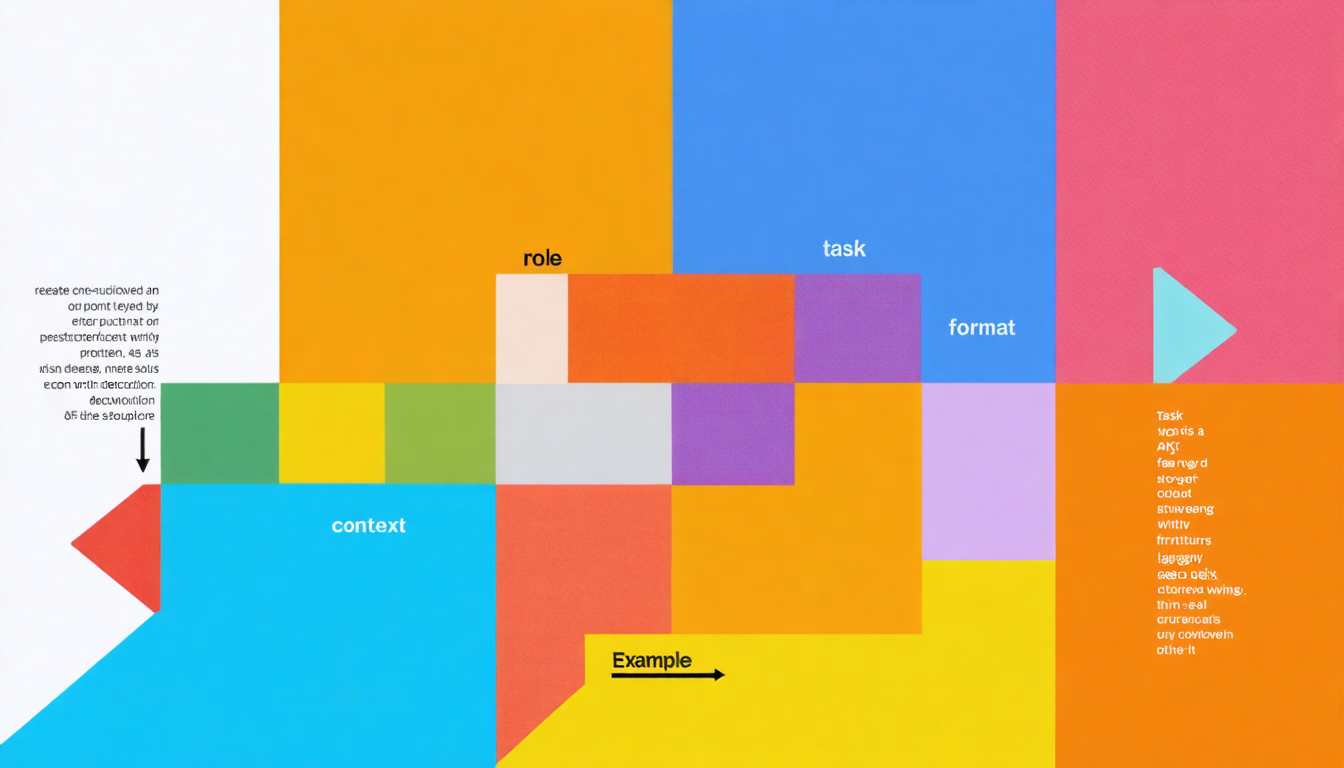
Architecture diagram for Prompt design fundamentals. The five core components of effective prompt construction arranged as sequential building blocks from left to right. Each block should be labeled (Role, Task, Context, Format, Examples) with brief descriptors inside: Role defines the perspective the AI takes, Task states the specific action, Context provides background and constraints, Format specifies output structure, and Examples show a sample of good output. Use arrows flowing rightward, with a feedback loop arrow curving back from Examples to Role to show iteration. Color-code each block distinctly (blue for Role, green for Task, orange for Context, purple for Format, yellow for Examples). Include a small annotation box below reading 'Draft, test, refine' with circular arrows. Style as a clean reference diagram with sans-serif labels and minimal decoration.
You'll be able to
- Build a prompt that gives the AI the five things it needs: who to be, what to do, the background, the shape of the answer, and an example of a good answer.
- Choose how you want the AI to act for a given task, for example as a doer that just produces the work or as a skeptical reviewer that pushes back on a draft.
- Decide whether to include a sample of good output (showing an example) or rely on clear instructions alone, and explain when an example earns its place.
- Refine a prompt by testing the output, spotting where it missed, and adjusting the instruction, not by switching tools or hoping for better luck.
Key concepts · tap to reveal
1/15·Watch·Beat 1 · Hook
0%
Hook
Same model, same task, one reply you can send, the other you have to rewrite. The difference? How you asked.
Your task Write a prompt that asks Claude to recommend the right AI setup for a real task you're facing — then weigh its answer against this lesson, "Prompt design fundamentals."
a strong prompt:role · context · task · format · example
Exercise · scenario
A support team sets up an AI assistant to help reps draft replies to billing questions. Their first prompt reads: 'Write a professional email response.' In testing, the replies are polite but never mention the company's actual refund policy and skip the customer's real question. The lead proposes three fixes: (A) add the role ('You are a billing support rep'), the policy details as context, and a required structure for the reply, (B) ask the AI to write longer responses, or (C) try a different AI tool with the same one-line prompt.
Deliverable
You will create a **Prompt Design Portfolio** as a Markdown document containing three prompt templates you could actually use at work. Pick three different everyday tasks, for example: rewrite a rough email so it is clear and professional, summarize a long report into a fixed format for a manager, and draft a customer reply that has to stay inside a stated policy.
Reveal model answer
Fix A addresses the core prompt design gap
Practice · Scenarios
0 of 8 revealed
Scenario 1 of 8
A city office uses an AI tool to summarize public comments on planning proposals. The summaries leave out dissenting views and blur the line between individual residents and organizations. The current prompt is: 'Summarize these comments.' Three changes are reviewed: (A) prepend 'Summarize this' and change nothing else, (B) state the task ('Identify and group every stakeholder position, noting agreements and objections'), set the role ('You are a neutral policy analyst'), and ask for a section per stakeholder type, or (C) add 'Be thorough' to the existing prompt.
Common misconceptions
“The AI will "understand what I mean" from a vague request, the way a coworker fills in the gaps”
AI tools are not mind readers. They generate the most likely continuation of the text you give them. Spell out role, task, context, format, and an example, and you steer that toward what you actually want. Leave it vague and you get the generic average, which may have nothing to do with your goal. When the answer is wrong, do not blame the model. Refine the instruction.
Sources
- [1]BioData Mining·From prompt engineering to agent engineering: expanding the AI toolbox with autonomous agentic AI collaborators (2025) · Research
- [2]Frontiers of Computer Science·A Survey of Large Language Models (2026) · Research
Submit your work for review
Paste your capstone artifact below. You'll get back a 4-level rubric grade, per-criterion feedback, and three concrete edits to strengthen it.