0of15read0 XP

The 4 D's: Delegation, Description, Discernment, Diligence
Name the loop you run every time you touch AI, Decide → Ask → Check → Own, and explain why it is a circle you return to, not a checklist you finish once.
- Time
- 20–25 min
- Type
- exercise
- Bloom
- Apply → Create
- XP
- 100
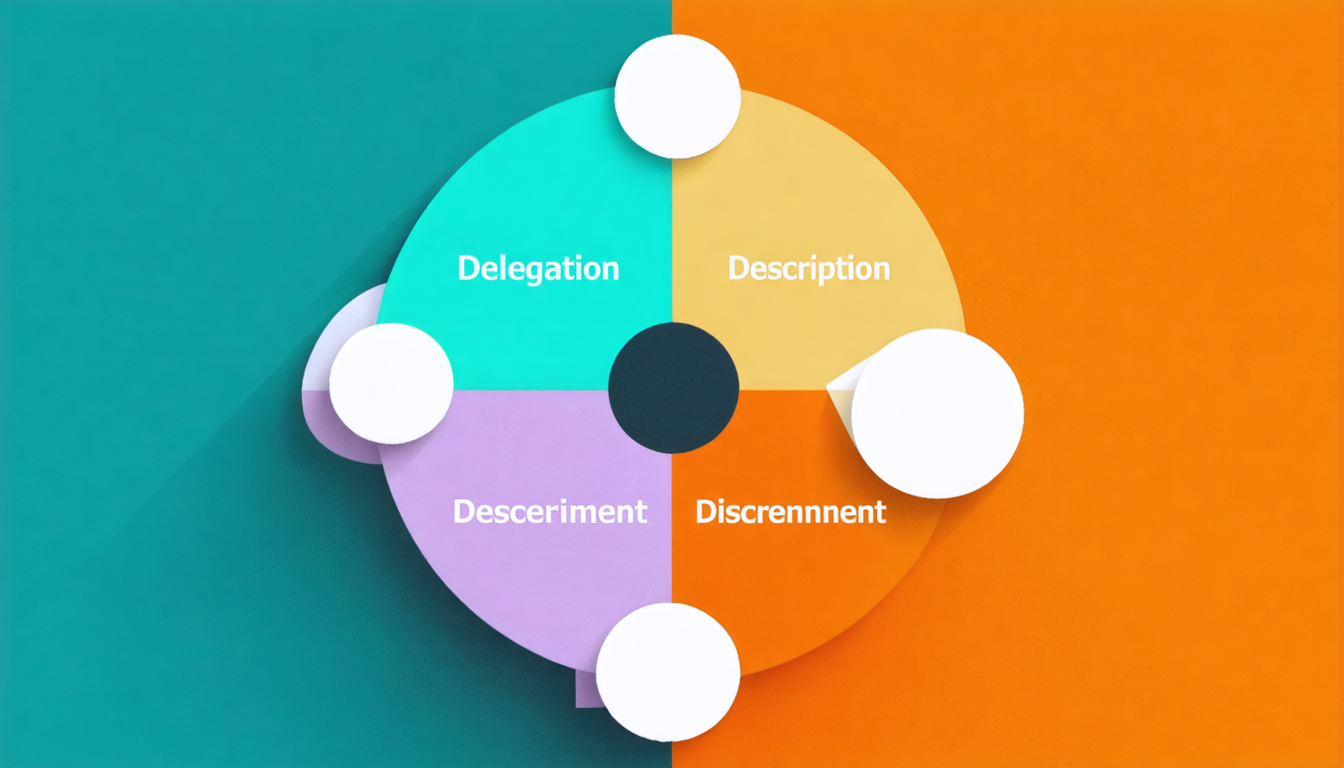
Architecture diagram for The 4 D's: Delegation, Description, Discernment, Diligence. Create a circular process flowchart showing the four moves of the loop arranged clockwise as a continuous cycle: Decide / Delegation (choosing what to hand to AI and what to keep), Ask / Description (writing a clear request with context and success criteria), Check / Discernment (evaluating the output past how confident it sounds), and Own / Diligence (verifying, disclosing, and accepting accountability for what you ship). Use four distinct quadrant colors. Place arrows connecting each move to the next, and one arrow from Own back to Decide to show it is a circle you return to, not a checklist. Central hub labeled "When it's wrong, it's on you." Each quadrant carries 2-3 short action cues: Decide includes stakes check and scope split; Ask includes context, examples, success criteria; Check includes spot the plausible error, accept/refine/reject; Own includes verify facts, disclose AI use, sign your name.
You'll be able to
- Name the loop you run every time you touch AI, Decide → Ask → Check → Own, and explain why it is a circle you return to, not a checklist you finish once.
- Decide (Delegation) which parts of a real task to hand to AI and which to keep, based on what the task needs and what happens if the AI gets it wrong.
- Ask (Description) for what you need clearly enough that the output is usable, by giving the AI context, examples, and success criteria instead of a vague request.
- Check (Discernment) an AI output against your own judgment and the facts, so you catch the plausible-sounding answer that is actually wrong.
- Own (Diligence) the result you ship, by verifying claims, disclosing AI involvement where it matters, and accepting that when it's wrong, it's on you.
Key concepts · tap to reveal
1/15·Watch·Beat 1 · Hook
0%
Hook
Your manager needs a customer proposal by morning. The AI can draft it, but which parts do you hand over, how do you ask, and how do you know the draft won't sink you?
Your task Write a prompt that asks Claude to recommend the right AI setup for a real task you're facing — then weigh its answer against this lesson, "The 4 D's: Delegation, Description, Discernment, Diligence."
a strong prompt:role · context · task · format · example
Exercise · scenario
An operations manager needs to forecast next quarter's staffing. She writes: 'Predict how many staff we'll need next quarter.' The AI returns a single number with no reasoning. She then revises: 'Estimate staffing needs for Q2 using our last 3 years of seasonal volume, the two new contracts starting in April, and a 5% turnover assumption. Give a range, not a point estimate, and flag anything in the historical data that looks unusual.' The second response includes a range, its assumptions, and data-quality notes.
Deliverable
**Artifact:** Add a page to your running AI Fluency Playbook titled "My 4-Move Policy." It defines how you personally run Decide, Ask, Check, and Own on AI-assisted work in your job. Write four sections, one per move, each containing: (a) a concrete rule for when you apply that move, (b) one real example prompt or workflow step you could run tomorrow, and (c) how you'll verify or vouch for the output, the thing you'd stake your name on.
Reveal model answer
Ask (Description), providing detailed context and success criteria
Practice · Scenarios
0 of 8 revealed
Scenario 1 of 8
A research coordinator is planning a literature review on new diabetes treatments. Instead of asking the AI to 'write a complete review paper,' she breaks the work into phases: first, identify peer-reviewed studies from 2020-2024; second, extract methodology and outcome data; third, synthesize findings by drug class. She reserves final interpretation, clinical relevance, and accuracy review for human experts on her team.
Sources
- [1]Anthropic AI Fluency Framework·Anthropic AI Fluency Framework (2025) · Vendor
Submit your work for review
Paste your capstone artifact below. You'll get back a 4-level rubric grade, per-criterion feedback, and three concrete edits to strengthen it.