0of15read0 XP

Modes of AI use: Automation, Agency, Augmentation
Classify real AI deployments into automation (AI works alone), agency (AI acts within bounds you set), or augmentation (AI assists, you decide), and recognize that in 2026 the tools default toward agency: they act on…
- Time
- 20–25 min
- Type
- exercise
- Bloom
- Apply → Create
- XP
- 100
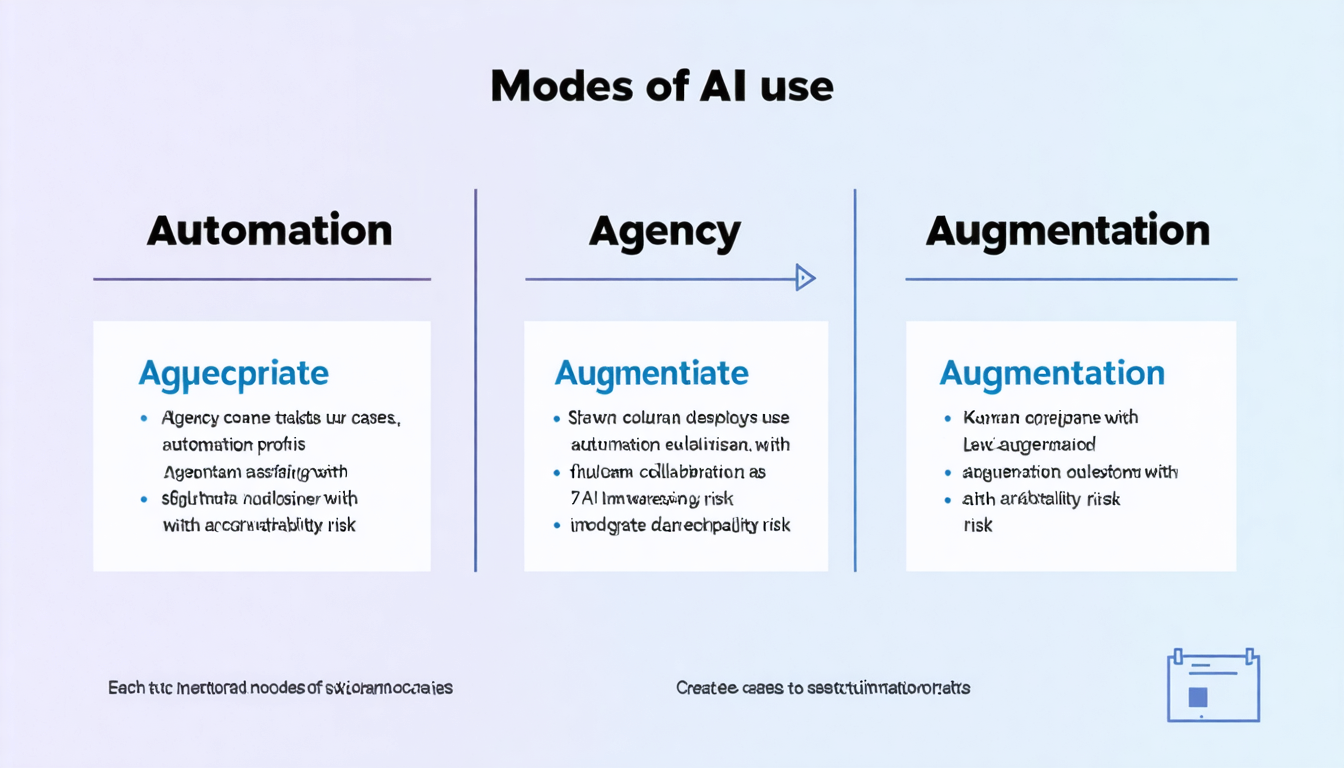
Architecture diagram for Modes of AI use: Automation, Agency, Augmentation. Three modes of AI use (Automation, Agency, Augmentation) as columns with two rows below: "Appropriate Use Cases" and "Risk Profile." Each cell contains 2-3 concise bullet points. Automation column shows routine tasks with low human oversight risk. Agency column displays autonomous decision-making with high accountability risk. Augmentation column presents human-AI collaboration with moderate interpretability risk. Use blue headers, light gray cell backgrounds, and orange risk-level indicators (low/medium/high icons). Add a footer reference line citing Anthropic's Constitutional AI principles and NIST AI RMF MAP function for governance context. Style as a clean technical reference table with sans-serif labels and consistent spacing between elements.
You'll be able to
- Classify real AI deployments into automation (AI works alone), agency (AI acts within bounds you set), or augmentation (AI assists, you decide), and recognize that in 2026 the tools default toward agency: they act on your behalf unless you draw a line[^5][^7]
- Evaluate what to hand AI and what to never hand it by weighing three factors, how high the stakes are, how much volume you're handling, and how reversible a mistake is, and apply the never-delegate rule: final sign-off, accountability, and irreversible high-stakes calls stay with you[^6][^7]
- Diagnose who owns the outcome when an AI system breaks, and explain how that accountability follows from what you chose to delegate at design time, not from how accurate the model is, you can delegate the work, not the accountability[^5][^6]
- Distinguish durable agentic capability from agent-washing and overclaimed autonomy, and build a risk profile for a real AI system by naming its mode, documenting where you keep your hand on the wheel, and stating one design change that moves accountability to the right actor[^5][^7][^8]
Key concepts · tap to reveal
1/15·Watch·Beat 1 · Hook
0%
Hook
In 2026 AI doesn't just answer; it acts on your behalf inside the tools you already use. Deciding what to hand it, and what to never hand it, is the call that matters most.
Your task Write a prompt that asks Claude to recommend the right AI setup for a real task you're facing — then weigh its answer against this lesson, "Modes of AI use: Automation, Agency, Augmentation."
a strong prompt:role · context · task · format · example
Exercise · scenario
A regional hospital network is implementing an AI system to process insurance pre-authorization requests. The system reviews submitted claims against policy criteria, automatically approves straightforward cases that meet all requirements, and flags complex cases for human review. Staff members can see the system's reasoning but cannot override approvals without supervisor escalation. The hospital's compliance officer notes that 87% of requests are now processed without human touch, reducing average processing time from 4 days to 6 hours.
Deliverable
You will produce a **three-mode AI use-case classification matrix** as a Markdown document. For each of three real-world AI systems you encounter in your work or study environment (e.g., a code-completion tool, a chatbot, a monitoring dashboard), document: (1) the primary mode (automation, agency, or augmentation), (2) the human-AI configuration and knowledge limits as described in MAP 2.2[^7], (3) the likelihood and magnitude of beneficial and harmful impacts per MAP 5.1[^6], and (4) one design recommendation drawn from human-AI interaction research to improve transparency or control[^8].
Reveal model answer
Automation - AI executes tasks independently within defined boundaries
Practice · Scenarios
0 of 8 revealed
Scenario 1 of 8
A global logistics company deploys an AI system to manage its fleet of 2,000 delivery vehicles across 15 countries. The system dynamically reroutes vehicles based on real-time traffic, weather, package priorities, and fuel costs. It independently negotiates delivery time windows with customers via automated messaging, reassigns packages between vehicles, and decides when to dispatch additional capacity. Human dispatchers monitor dashboards but intervene only when the system requests assistance for scenarios outside its training data, which occurs in approximately 3% of decisions.
Common misconceptions
“The newest tools are agentic now, so the smart move is to let them run, hand the agent the task and trust it, because supervising it defeats the point”
Agency means the AI acts within bounds
Quiz · adaptive · 3 items
Mastery check
Match each term to its definition. Pass at 80% to earn the lesson's XP and unlock the next.
Sources
- [1]NIST AI Risk Management Framework 1.0·NIST AI Risk Management Framework 1.0 > Function: MANAGE > Category: MANAGE 4 Risk > MANAGE 4.3: Incidents and errors are communicated to re (2025) · Regulation
- [2]OpenAlex API·OpenAlex API > Guidelines for Human-AI Interaction > INTRODUCTION (2025) · Research
Submit your work for review
Paste your capstone artifact below. You'll get back a 4-level rubric grade, per-criterion feedback, and three concrete edits to strengthen it.