0of15read0 XP
Where your data goes: privacy, terms, and what 'cloud' means
Explain what 'the cloud' actually means in plain terms: your data sits on a company's physical servers in a real building, not a vague place, and you do not control those machines.[^2]
- Time
- 20–25 min
- Type
- exercise
- Bloom
- Apply → Create
- XP
- 100

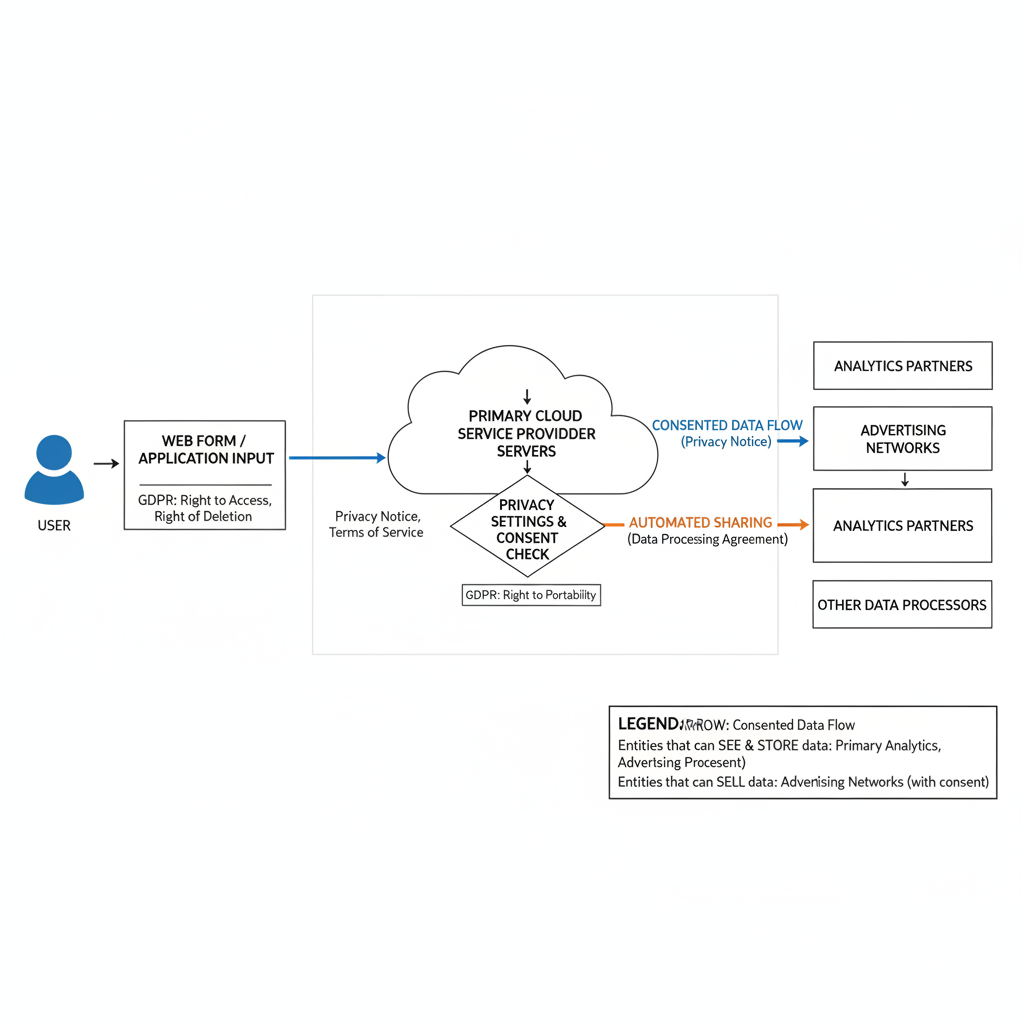
Architecture diagram for Where your data goes: privacy, terms, and what 'cloud' means. The journey of user data from input through cloud services to third-party destinations. Start with a user icon at the left entering data into a web form or application. Show the data flowing through three main stages: (1) the primary service provider's servers with a cloud symbol, (2) a decision diamond checking privacy settings and consent status, and (3) multiple endpoints including analytics partners, advertising networks, and data processors. Label each connection with the governing document (Privacy Notice, Terms of Service, Data Processing Agreement). Use blue arrows for consented data flows and orange arrows for automated sharing. Include small text boxes at key points indicating data rights (access, deletion, portability). Add a legend showing which entities can see, store, or sell the data. Use a left-to-right layout with the cloud infrastructure in the center and third parties branching to the right.
You'll be able to
- Explain what 'the cloud' actually means in plain terms: your data sits on a company's physical servers in a real building, not a vague place, and you do not control those machines.[^2]
- Examine a privacy notice to find what personal information a service collects (such as your name, device, or location) and whether it shares that information with advertisers or other companies.[^2]
- Evaluate a Terms of Service agreement to spot clauses that let a company keep, reuse, or share what you upload, recognizing that clicking 'I agree' binds you even if you never read it.[^2]
- Distinguish between paid and free services in terms of how each makes money from your data, understanding that with free services you are often the product.[^2]
- Apply simple privacy habits at work: pause before pasting sensitive information into online tools, check the terms, and strip out what does not need to be there.[^1][^2]
Key concepts · tap to reveal
1/15·Watch·Beat 1 · Hook
0%
Hook
Where does your data go when you click 'paste'?
# task Write a prompt that asks Claude to recommend the right AI setup for a real task you're facing — then weigh its answer against this lesson, "Where your data goes: privacy, terms, and what 'cloud' means."
▸ console ready. write a prompt below and press ↵ to run it with Claude.
Exercise · scenario
A freelance graphic designer in Portugal gets a project brief by email and immediately pastes the client's confidential product specifications into a free online design tool to generate some early concepts. The tool's website mentions 'cloud-based processing' but has no clear privacy notice. The client later asks whether their unreleased product details might now be in the hands of the tool's maker. The designer realizes they never checked the tool's terms or how it handles data before uploading the client's information.
Deliverable
**Build a one-page "where does my data go" check for your own work.**
Reveal model answer
Privacy risk, the designer may have shared client data with another company without understanding how it is kept, accessed, or reused
Practice · Scenarios
0 of 8 revealed
Scenario 1 of 8
A small bakery owner in Belgium uses an online accounting service to handle invoices and customer orders. Its privacy notice says data is 'encrypted in transit and at rest' and stored on servers in Frankfurt, Germany. Six months later, the owner gets an email saying the service has been bought by a US company and that 'to improve service, customer data will now be processed on our global infrastructure, including facilities in Virginia, USA.' The email links to updated terms but offers no choice except deleting the account.
Sources
- [1]Plain Language Guidelines (plainlanguage.gov)·Plain Language Guidelines (plainlanguage.gov) (2025) · Vendor
- [2]DigComp 2.2 (EU Digital Competence Framework, JRC128415)·DigComp 2.2 (EU Digital Competence Framework, JRC128415) (2025) · Research
Submit your work for review
Paste your capstone artifact below. You'll get back a 4-level rubric grade, per-criterion feedback, and three concrete edits to strengthen it.