0of15read0 XP

Choosing AI tools by the four moves
Evaluate any AI tool against the four moves of the loop, Decide, Ask, Check, Own, using a concrete question for each move rather than a feature list.
- Time
- 20–25 min
- Type
- exercise
- Bloom
- Apply → Create
- XP
- 100
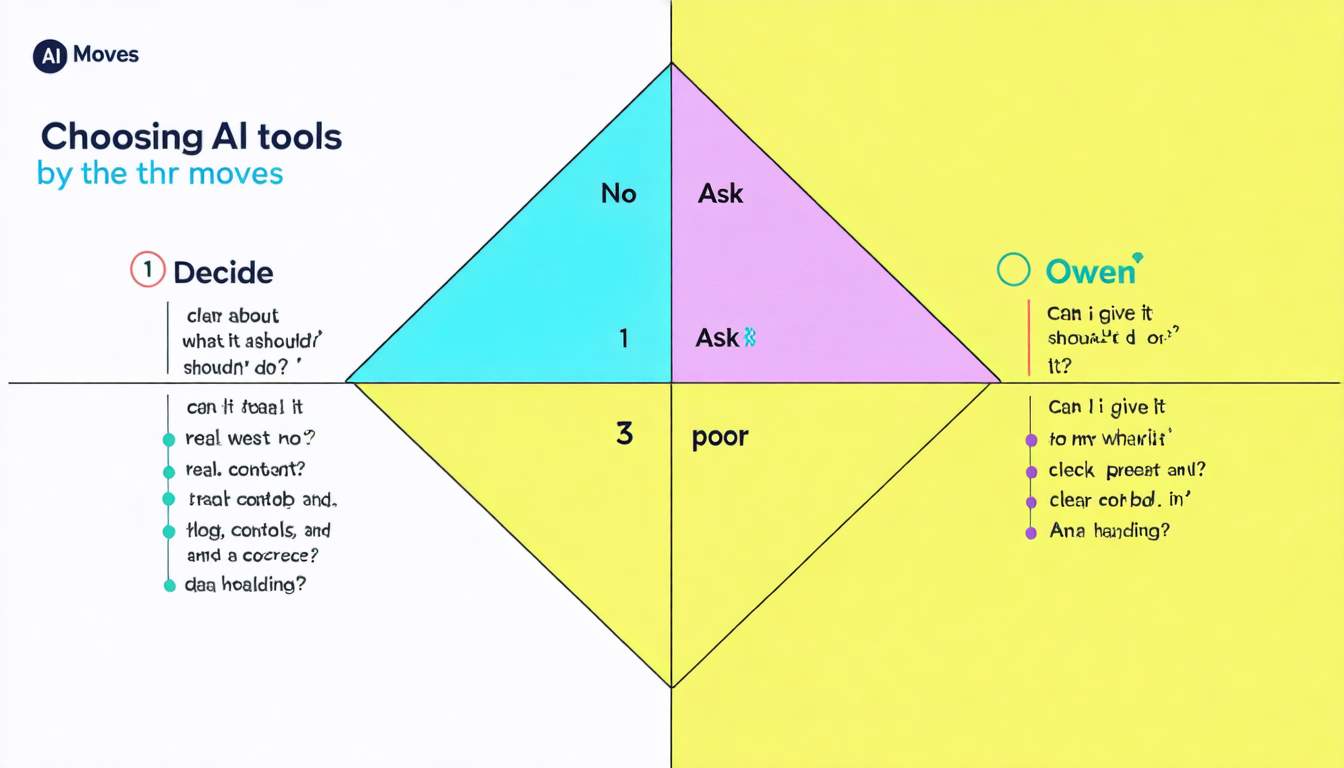
Architecture diagram for Choosing AI tools by the four moves. A four-quadrant scorecard, one quadrant per move, Decide, Ask, Check, Own, each with its scoring question ('clear about what it should/shouldn't do?', 'can I give it real context and steer it?', 'can I see what to trust and trace it to a source?', 'is there a log, controls, and clear data handling?') and a good/partial/poor marker. Below the quadrants, a single verdict bar reading 'good enough / fine with outside verification / wrong tool' and a 'carry-list' callout for the weakest move. Warm gold on near-black.
You'll be able to
- Evaluate any AI tool against the four moves of the loop, Decide, Ask, Check, Own, using a concrete question for each move rather than a feature list.
- Apply that rubric to a tool you actually use at work and produce a one-line verdict: good enough for the task, fine with outside verification, or wrong tool for the job.
- Diagnose which move a tool is weakest on, and decide what you'll carry yourself to cover the gap.
Key concepts · tap to reveal
1/15·Watch·Beat 1 · Hook
0%
Hook
Pick your tools the same way you run everything else here: by the four moves. A demo tells you it's fast and smart. It doesn't tell you if it keeps you in command.
Your task Write a prompt that asks Claude to recommend the right AI setup for a real task you're facing — then weigh its answer against this lesson, "Choosing AI tools by the four moves."
a strong prompt:role · context · task · format · example
Exercise · scenario
An AI writing tool produces a polished draft, but when it states a fact it uses the same confident tone whether it's accurate or invented, and it never links back to a source you can open. You're deciding whether to use it for a client report.
Deliverable
**Artifact:** Produce a **Four-Move Tool Scorecard** for one AI tool you actually use, as a short Markdown document. It must include: (1) the tool name and the specific task you'd use it for; (2) a score for each of the four moves, Decide, Ask, Check, Own, marked good, partial, or poor, each with one sentence of evidence from your real use; (3) a one-line verdict for that task (good enough / fine with outside verification / wrong tool for this); and (4) a carry-list: the move or moves the tool is weakest on, and the concrete thing you'll do yourself to cover each gap.
Reveal model answer
Weak on Check, you can't tell what to trust or trace a claim to a source
Practice · Scenarios
0 of 3 revealed
Scenario 1 of 3
A specialized AI tool only accepts a short text box as input. You can't attach your own documents, can't give it a format to follow, and when its first answer misses your constraints, there's no way to feed those constraints back in, you just get a fresh generic answer.
Common misconceptions
“the best AI tool is the most capable one”
the best tool for a task is the one that keeps you in command of the loop for that task. A wildly capable tool that hides its sources (poor Check) and keeps no log (poor Own) is the wrong tool for anything you have to stand behind, no matter how good the output looks.
Sources
- [1]Frontiers of Computer Science·A Survey of Large Language Models (2026) · Research
- [2]BioData Mining·From prompt engineering to agent engineering: expanding the AI toolbox with autonomous agentic AI collaborators (2025) · Research
Submit your work for review
Paste your capstone artifact below. You'll get back a 4-level rubric grade, per-criterion feedback, and three concrete edits to strengthen it.