0of15read0 XP
Verification + sourcing literacy: how to check what AI told you
Check AI-generated claims by breaking them into specific facts, finding the official sources those facts should come from (vendor docs, government sites, published research), and seeing whether the sources actually say…
- Time
- 20–25 min
- Type
- exercise
- Bloom
- Apply → Create
- XP
- 100
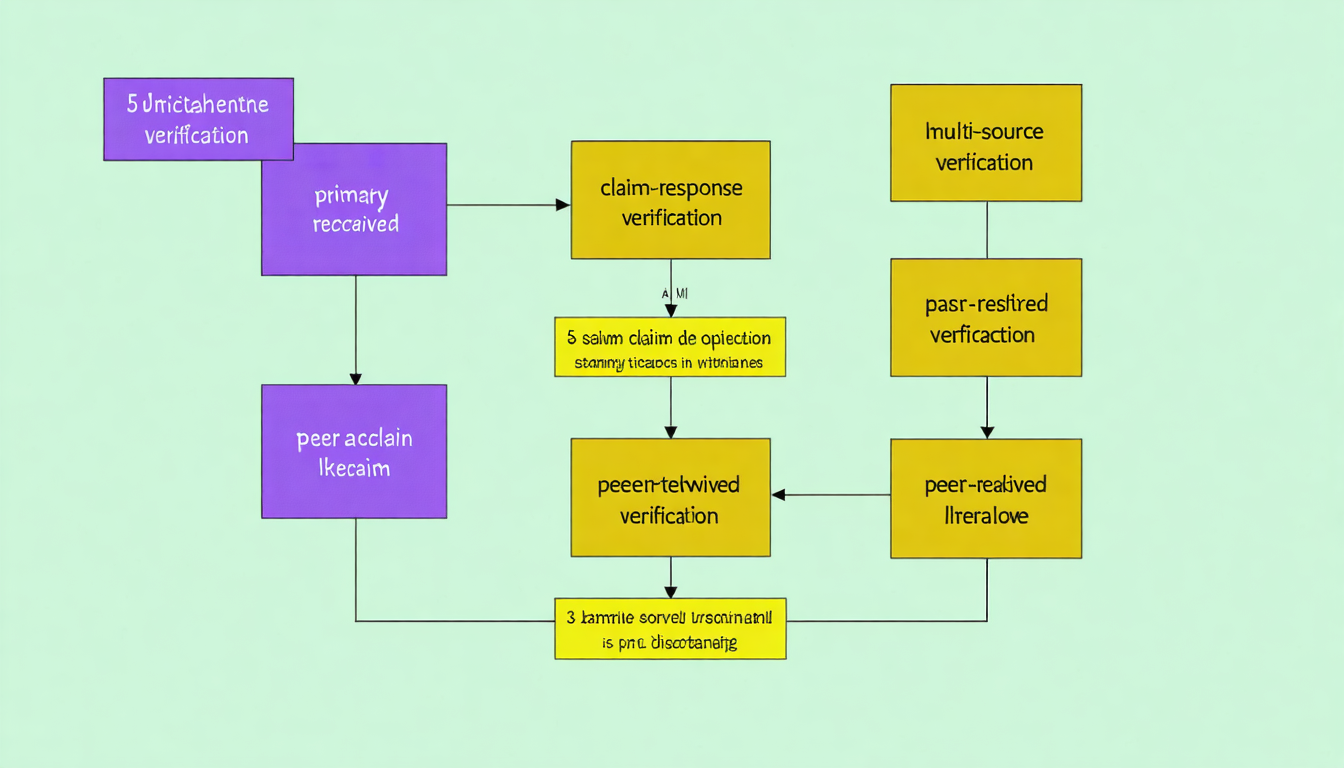
Architecture diagram for Verification + sourcing literacy: how to check what AI told you. Flowchart diagram showing the AI output verification workflow in four sequential swim-lanes: (1) AI Response Received (purple box with sample claim), (2) Claim Extraction (yellow boxes breaking statement into discrete factual assertions), (3) Multi-Source Verification (three parallel green paths labeled "Primary Sources," "Vendor Documentation," and "Peer-Reviewed Literature" with magnifying glass icons), and (4) Confidence Assessment (red-to-green gradient scale showing "Hallucinated," "Partially Grounded," and "Fully Verified"). Include decision diamonds asking "Sources agree?" and "Primary source found?" with arrows looping back to "Flag for manual review" or forward to "Accept with citation." Add small icons: database for authoritative sources, warning triangle for conflicts, checkmark for verified claims. Use clean technical style with sans-serif labels.
You'll be able to
- Check AI-generated claims by breaking them into specific facts, finding the official sources those facts should come from (vendor docs, government sites, published research), and seeing whether the sources actually say what the AI claimed.
- Sort information sources by trustworthiness: official documentation and original research beat blog posts and summaries; recognize when AI outputs might reflect commercial interests, training-data gaps, or made-up details that need independent confirmation.
- Trace AI answers back to their roots: pull out specific numbers or technical claims, search for them in known-good places, check multiple independent sources, and flag mismatches or invented citations before you use the information in production.
- Build a verification record for high-stakes AI outputs: write down the original claim, the authoritative sources you checked, what you found (supported, contradicted, or missing), and any corrections you made, so the next person can see where the information came from and whether it's solid.
Key concepts · tap to reveal
1/15·Watch·Beat 1 · Hook
0%
Hook
An AI tells you something that sounds authoritative. Before you memorize it, you need a process to check whether it's real.
Your task Write a prompt that asks Claude to recommend the right AI setup for a real task you're facing — then weigh its answer against this lesson, "Verification + sourcing literacy: how to check what AI told you."
a strong prompt:role · context · task · format · example
Exercise · scenario
A municipal water utility engineer receives an AI-generated summary claiming that 'EPA Maximum Contaminant Levels for lead in drinking water were revised to 10 ppb in 2023, down from the previous 15 ppb standard.' The engineer needs to incorporate this into a compliance report due tomorrow. She opens a new browser tab and searches 'EPA lead MCL 2023' and finds the official EPA.gov page showing the action level remains 15 ppb with no 2023 revision. She also checks the Federal Register and finds no recent lead MCL rule changes.
Deliverable
Produce a **Verification Audit Report** as a markdown document that demonstrates your ability to systematically check AI-generated claims against primary sources. Select one AI-generated answer you received during this course (from a chatbot, code assistant, or documentation tool) and decompose it into three to five atomic claims.
Reveal model answer
Primary source verification with authoritative government databases
Practice · Scenarios
0 of 8 revealed
Scenario 1 of 8
A nonprofit advocacy director is preparing testimony for a state legislative hearing on housing policy. An AI tool generates talking points including 'According to HUD's 2023 Annual Homeless Assessment Report, chronic homelessness increased 28% nationally, with the steepest rises in rural counties.' The director visits HUD.gov, downloads the actual 2023 AHAR, and finds that chronic homelessness increased 12% (not 28%), and the report explicitly states urban areas saw the largest increases, not rural counties. The director removes the AI-generated claim and replaces it with direct quotes from the HUD report, including page numbers. What verification literacy practice did the director demonstrate, and why does this matter for policy advocacy?
Common misconceptions
“If an AI provides a citation or a reference, the claim is verified and trustworthy”
AI systems can fabricate citations that look real but point to nonexistent documents, or they can cite real documents that do not actually support the claim. You must independently retrieve the cited source and confirm that the relevant passage says what the AI claims it says. Research on financial AI systems found that large language models invent citations as part of the same hallucination process that produces fabricated facts. Verification means checking the source yourself, not trusting that the AI checked it for you.
Quiz · adaptive · 3 items
Mastery check
Match each term to its definition. Pass at 80% to earn the lesson's XP and unlock the next.
Sources
- [1]OpenAlex API·OpenAlex API > “Your argumentation is good”, says the AI vs humans, The role of feedback providers and personalised language for feedb > Abs (2025) · Research
- [2]arXiv API·arXiv API > FinGround: Detecting and Grounding Financial Hallucinations via Atomic Claim Verification > Abstract (2025) · Research
- [3]DigComp 2.2 (EU Digital Competence Framework, JRC128415)·DigComp 2.2 (EU Digital Competence Framework, JRC128415) (2025) · Research
- [4]OpenAlex API·OpenAlex API > Guidelines for Human-AI Interaction > INTRODUCTION (2025) · Research
- [5]OpenAlex API·OpenAlex API > Mindstorms: Children, Computers, and Powerful Ideas (foreword + intro) > limitations (2025) · Research
Submit your work for review
Paste your capstone artifact below. You'll get back a 4-level rubric grade, per-criterion feedback, and three concrete edits to strengthen it.